Every dealer already believes that some leads come in after hours. It gets said in every vendor pitch and every 20 Group meeting. What almost nobody has is the actual shape of it: which hours, how many, and how fast the volume really falls off after the doors lock.
So we measured it.
We took every internet lead that arrived at our dealerships over the last 90 days, 5,867 of them, and bucketed each one by the hour it actually landed in that store's local time. Not when a CRM synced it. Not when someone opened it. When the customer hit submit.
Here is what came back.
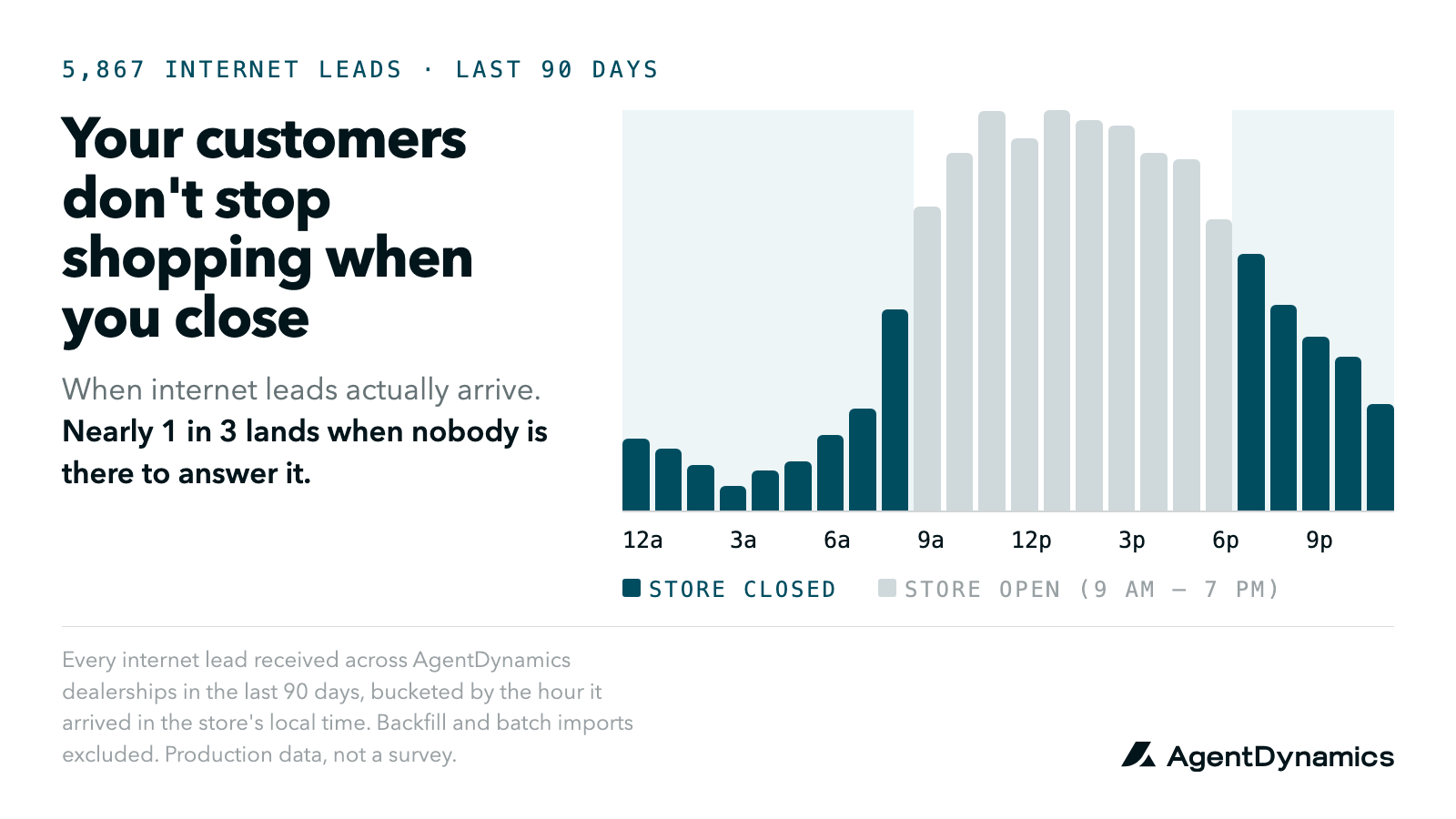
Nearly one in three leads arrives when the store is closed
Measured against a 9 AM to 7 PM window, 1,775 of 5,867 leads, 30.3%, arrived outside business hours.
That number is almost certainly conservative. A flat 9-to-7 window does not account for Sundays, holidays, or the stores that close at 6. Every one of those pushes the real figure higher, not lower. We would rather understate it.
The evening does not fall off a cliff. It tapers for six hours.
This is the part that surprised us.
Lead volume behaves the way you would expect during the day: it starts moving at 7 AM, climbs hard through the morning, and peaks between 11 AM and 3 PM. Then the store closes, and the intuition most people have is that the traffic stops.
It does not. It declines gently, hour by hour, all the way to midnight.
1,016 leads, 17.3% of everything we measured, arrived between 7 PM and midnight. The 8 PM hour by itself pulled in 233 leads, slightly more than the 8 AM hour, which pulled 228. Your evening is not a dead zone. It is a full morning's worth of demand, arriving into an empty building.
Even the small hours are not empty. Between midnight and 6 AM, when there is not a human being awake in any dealership in the market, 331 leads came in. That is 5.6% of total volume, submitted by people shopping for a car in the middle of the night.
Why this is expensive
A customer who submits a lead at 9:40 PM is actively shopping at 9:40 PM. They are on their couch with a phone, and they are almost never on one dealer's website. They are on three.
The store that answers first, with a real answer about a real car, gets the appointment. That is not a theory, it is the oldest finding in lead response research, and it has not stopped being true.
So the question is not whether your evening leads are valuable. They are the same leads. The question is what happens to them between 7 PM and 9 AM the next morning, and for most stores the honest answer is: nothing. They sit. By the time a BDC agent picks one up at 9:15 the next day, the customer has already talked to somebody else, or gone quiet, or bought.
That gap is not a failure of effort. It is arithmetic. A BDC team that is fully staffed during business hours is, by definition, not staffed outside them.
How we counted
We are publishing the method along with the number, because a statistic you cannot check is just marketing.
What is in. Every internet lead received by an AgentDynamics dealership in the 90 days ending July 14, 2026, across stores running Toyota, Ford, Chevrolet, Kia, and Nissan franchises in multiple US markets and time zones.
Local time, not server time. Each lead was bucketed by the hour it arrived in its own store's timezone. An 8 PM lead in Houston and an 8 PM lead in Chicago both count as 8 PM.
Arrival time, not delivery time. This is the detail that matters most, and the one that would have quietly corrupted the whole study if we had not caught it. Some CRM feeds hand you a lead hours or days after the customer submitted it, and if you timestamp the lead when it lands in your system, you will invent an after-hours spike that never happened. Where a feed gave us the customer's true submission timestamp, we used that. Where a CRM was back-filling historical records in bulk, we excluded those days entirely rather than let sync-cron timing masquerade as shopper behavior.
What is out. Backfills, batch imports, and demo or test data. One CRM handed us more than 17,000 historical records in a single afternoon. None of them are in this study.
The window. A flat 9 AM to 7 PM definition of "open." Real store hours vary, and most of the variance runs in the direction of making our number larger, not smaller.
Run this on your own store
You do not need us to do this. If you can export your leads with a submission timestamp, do exactly what we did:
1. Pull every internet lead from the last 90 days with the timestamp the customer submitted it, not the date it appeared in your CRM.
2. Convert to your store's local time.
3. Count how many landed outside your posted hours.
4. Then, for the ones that landed after close, check the timestamp of your first outbound response.
Step four is where it usually gets uncomfortable. Most stores find the lead volume is roughly what we found. What they do not expect is how long the answer took.
If your CRM will not give you a clean submission timestamp, that is worth knowing too. It means the numbers you have been reporting on response time are measured from the wrong starting line.
---
This is the first edition of an ongoing series. We run AI across voice, text, and email for dealerships, which means we sit on production data about how car shoppers actually behave, and almost nobody in this category publishes any. We intend to, every quarter, including the findings that are inconvenient for us.
Questions about the methodology, or want the hour-by-hour numbers behind the chart? Email yogesh@agentdynamics.ai.